
Showing posts with label planning. Show all posts
Showing posts with label planning. Show all posts
Thursday, 8 December 2011
Editing: Log sheet
Whilst filming, we have also begun the editing process using iMovie but before that we reviewed our footage using a log sheet. As you can see, the log sheet is very helpful in allowing us to organise the clips we will use in our trailer and make decisions regarding what needs to be re-shot due to visual or audio issues. Using the time markers I made on the log sheet (e.g. "00:02 to 00:12") in iMovie also sped up the process of cutting the clips.


Monday, 7 November 2011
Makeup and Special Effects
In the Film's Cool session last Thursday, we were given a talk about industry practices by Oscar winning makeup artist Christine Blundell and Cliff Wallace who also gave us advice on how to do special effects and make up for a horror movie on a budget. For example, I found out a low cost method of creating fake blood using food colouring and golden syrup. Cliff also advised that for the scene involving the wounded character, we should also use painted tissue pasted on with Copydex to look like skin/flesh cut with a knife.

An example of Christine's work
Monday, 31 October 2011
Planning for Production: Celtx


In class we have been using the industry standard software Celtx to write up our screenplays. The programme also allows the user to organise the entire production by creating a database of actors, characters, locations, sound effects, text, props and makeup. Finally, it can create a Production Schedule tailored to the times of day specified in the scene headings (e.g. 'EXT. SCHOOL GATE, ACLAND BURGHLEY SCHOOL. DAY').
Thursday, 20 October 2011
Music
In my post analysing the 'Grave Encounters' trailer, I made a note of the sound effects and music used which highlight the themes of alienation while giving it a creepy atmosphere. We hadn't considered the music in our trailer much until the Film's Cool session with Awate which helped us think about the atmosphere we were trying to create and how his music would allow us to do that. We decided on the track 'Firm' because it has some typical horror movie stings in it, but the hip-hop genre adds to the contemporary feel of the trailer.
Sunday, 16 October 2011
Planning for Production

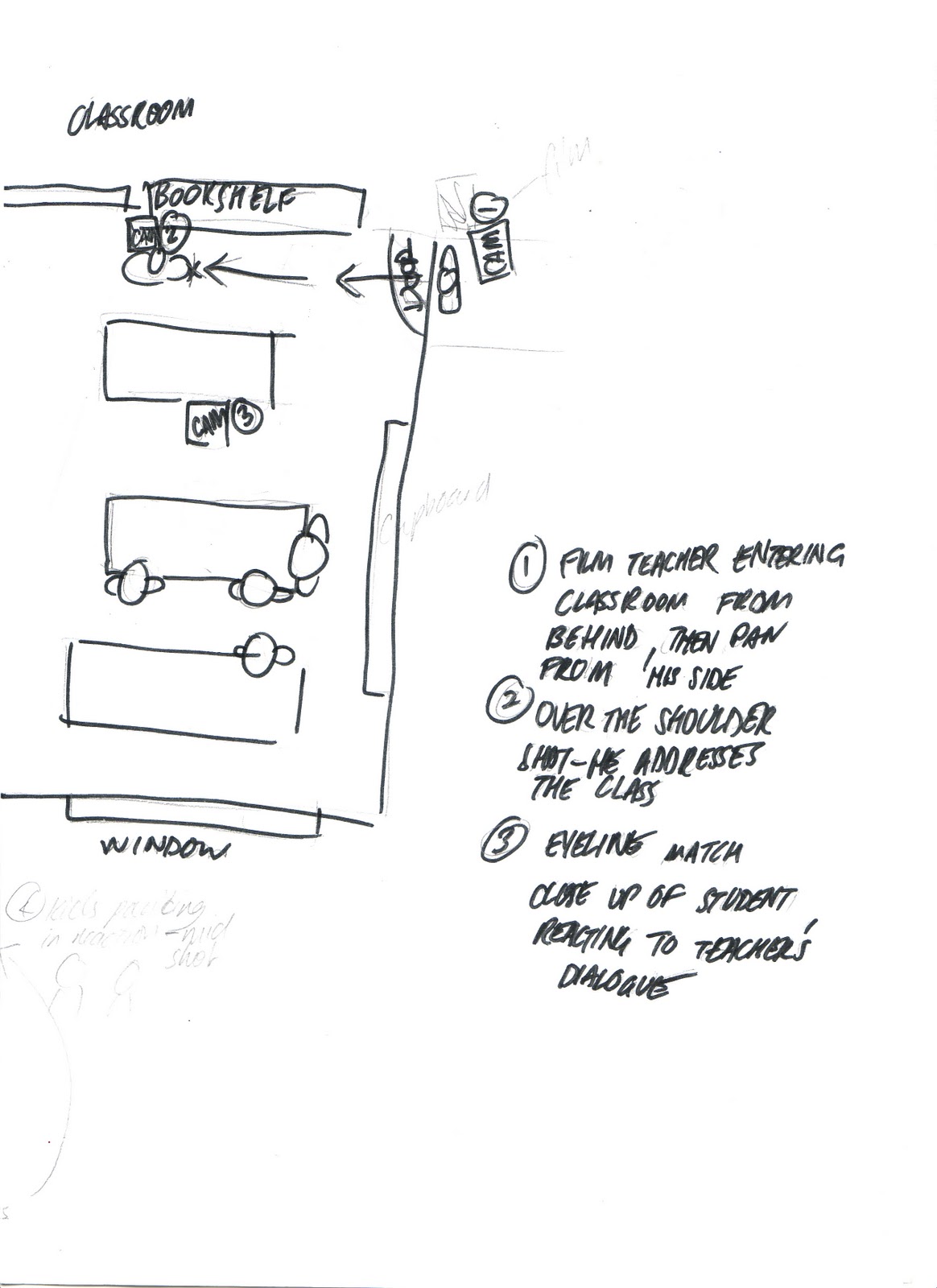
These rec drawings have helped us think about how ,on a practical level, we are going to shoot the trailer. They show where in the classroom location the camera will be placed, the movements the camera operator will make as well as the actors' movements. Additionally we have updated the storyboard to reflect the new plot and change of the film's name.


Planning for Production


With the help of industry experts at the Film's Cool session I developed the ideas the group had already formed for the trailer. The storyboard shown above is what we have agreed to shoot and create titles for. The trailer, like others does not fall in line with Todorov's narrative theory as it does not show the last stage of resolution. The trailer follows conventions of the genre but we may choose to use variation in the style of the trailer (the beginning which introduces different teacher 'types' before showing the audience the antagonist, the evil science/maths teacher) and the characterisations displayed (e.g. depicting uniquely English stereotypes).
Tuesday, 11 October 2011
BBFC Restrictions - How will they affect my trailer?

- not promote or encourage drug use
- not endorse discriminatory language or behaviour
- only include horror elements that are 'non sexualised or sadistic'
- not glamourise risky behaviour and easily accessible weapons
- not include repeated aggressive uses of strong language - only one use of non threatening strong language is allowed in a '15' trailer
- feature themes appropriate for 15 year olds
Monday, 10 October 2011
Planning for Production
"Detention"
Synopsis
The film's premise is that a teacher, driven to the edge by unruly students is the killer in a London school. He strikes during after school (or Saturday) detention, allowing him to not be caught and exact his revenge on the tormenting teens. The main targets are six students, one of whom will be the protagonist/hero who survives.
Protagonist and Stock Characters
We have chosen to follow the convention other films use of having an adult male as the antagonist. However we will employ variation by having him be in a role of authority (a teacher) and not on the fringe of society which will express the fear of abuse of power within society. The stock characters will be teenagers (six in total, adhering to the convention of having a higher ratio of male to female characters)who exemplify youth subcultures in London and will fit in with the established roles such as the Wanderer, the Popular Girl, the Final Girl etc. Our stock situation of a school detention allowed us to make use of different stereotypes among school students which will help foster a sense of Personal Identity (as identified in Blumler and Brown's uses and gratifications theory) within our target audience. The characters we have developed exhibit some of the same aspects with those identified Goffman's character theory as opposed to Propp's theory which characters of the horror genre rarely fit in with. The following is a list of the characters that will feature in the trailer:


Location
We will film within the grounds of Acland Burghley school and we have identified a particular location (shown in the above photos) underneath the school building in which we would like to film as it will lend an eerie, spooky atmosphere to our film trailer. This location is ideal in terms of logistics as the equipment we will borrow from the school can be easily transported within the school building as opposed to outside it. However this requires us to consider Health & Safety as we will be using young actors and do not want to endanger them. Furthermore, this closed setting will highlight the theme of entrapment suggested by the title 'Detention'.
Iconography and settings will be repeated and varied in the trailer to convey the genre of the film. These could include:

Synopsis
The film's premise is that a teacher, driven to the edge by unruly students is the killer in a London school. He strikes during after school (or Saturday) detention, allowing him to not be caught and exact his revenge on the tormenting teens. The main targets are six students, one of whom will be the protagonist/hero who survives.
Protagonist and Stock Characters
We have chosen to follow the convention other films use of having an adult male as the antagonist. However we will employ variation by having him be in a role of authority (a teacher) and not on the fringe of society which will express the fear of abuse of power within society. The stock characters will be teenagers (six in total, adhering to the convention of having a higher ratio of male to female characters)who exemplify youth subcultures in London and will fit in with the established roles such as the Wanderer, the Popular Girl, the Final Girl etc. Our stock situation of a school detention allowed us to make use of different stereotypes among school students which will help foster a sense of Personal Identity (as identified in Blumler and Brown's uses and gratifications theory) within our target audience. The characters we have developed exhibit some of the same aspects with those identified Goffman's character theory as opposed to Propp's theory which characters of the horror genre rarely fit in with. The following is a list of the characters that will feature in the trailer:
- The teacher/serial killer. We could hint at some sort of instability within his life by ascribing him certain characteristics (he might be quite eccentric, for instance). The catalyst for his drastic change in behaviour (i.e. what makes him suddenly start killing) is his students' constant tormenting which borders on abuse.
- The 'leader' of the students, a character that might fit in with the Jock stereotype seen in American horror movies.
Location
We will film within the grounds of Acland Burghley school and we have identified a particular location (shown in the above photos) underneath the school building in which we would like to film as it will lend an eerie, spooky atmosphere to our film trailer. This location is ideal in terms of logistics as the equipment we will borrow from the school can be easily transported within the school building as opposed to outside it. However this requires us to consider Health & Safety as we will be using young actors and do not want to endanger them. Furthermore, this closed setting will highlight the theme of entrapment suggested by the title 'Detention'.
Iconography and settings will be repeated and varied in the trailer to convey the genre of the film. These could include:
- a 'disfiguring' mask worn by the killer
- a murder weapon such as a knife, stake or chainsaw
- the darkened, forbidden chamber where the killer lurks
- the school building (in the establishing shot) which is incongruous with the themes of horror, further unsettling our audience
These potent symbols will also emphasise the key themes of the film which are alienation, abuse of power and distrust of authority in society (depicting them on a microcosmic scale).
Thursday, 4 August 2011
The Meeting 2: Planning
Once the group watched the video of the first filming task and received feedback from the rest of the class, we decided that in order to improve, we needed our next effort to planned in greater depth. To begin with we changed the story to make it easier to follow. We wanted to depict a situation that would allow us to use different shot types so we changed our idea to a job interview. In the scenario, the interviewee becomes distracted which meant we could use an eyeline match as shown below in our first storyboard.

Some things we needed to consider in coming up with our storyboard were:

Some things we needed to consider in coming up with our storyboard were:
- Location: we chose a job interview because we knew it would be easy to make a classroom in the school look like an office and it had to be somewhere that wouldn't be too noisy. Another advantage was that the classroom was well lit
- Props and costume
- The weather as it would have an impact on whether or not we did our external establishing shots inside or outside (in the end, the establishing shot was filmed indoors)
- Limitations we would face and how we would get around them: for example, setting the tripod on a table to film at a higher angle
- Where the camera-person would be filming from so we didn't break the 180 degree rule and ensured continuity
After this I was given the task of writing the script. I had to write one that would be easily adaptable, simple and stuck to the basic plot. It also had to fit the given time frame of a few minutes and effectively communicate the stage directions to the actors as shown below in the first draft.
Thursday, 16 June 2011
Preliminary Task 1: The Meeting
On the first day of starting A2 Media Studies, we were presented with our first task to create a short film about 'a meeting' using minimal editing. The purpose of the brief was to give us experience of using the technology employed in film-making (we will be using video cameras, tripods and uploading software). The brief stated that all editing would be done 'in-camera' and required us to use six shots, including some of the following shot types, film concepts and camera movements:
Planning the sequence
The other members of my group and I had to carefully consider how to portray 'the meeting' in a limited number of shots. We came up with a story about a patient meeting their doctor and created a storyboard showing the types of shot used; firstly, an establishing shot which was a long shot including panning from left to right; a mid shot that would become a close up with the use of zooming and a two-shot showing the meeting, amongst others.
Next, we had to consider location as filming in school limited us. We decided to film mostly in the classroom. Finally, the script was written.

Filming the sequence
When we were actually filming, we changed our ideas somewhat, deciding to only use one location which was a much more reasonable approach. We did not use an establishing shot, which negatively affected the film and the script was heavily edited. I was given the responsibility of acting in the sequence and I gave some direction to the person operating the camera. However it was evident the scene was not very well planned as we had to do quite a few takes to establish how the camera would move and organise the blocking of both actors. We also had to take continuity into consideration; although the editing makes it seem as if we used jump cuts, we put the props back into place after deleted takes.
Editing
The editing of the film was minimal. The video from the flip camera was uploaded and simple cuts were added to the film in iMovie. The editing of the film was not a collaborative effort and I felt the group members responsible left out too much of the shots we filmed. In future I think if possible all of the group should be involved in the editing process.
- Close up
- Mid shot
- Long/wide shot
- Shot reverse shot
- Pan left/right
- Zoom in/out
- Tilt up/down
- Framing
- 180 degree rule
Planning the sequence
The other members of my group and I had to carefully consider how to portray 'the meeting' in a limited number of shots. We came up with a story about a patient meeting their doctor and created a storyboard showing the types of shot used; firstly, an establishing shot which was a long shot including panning from left to right; a mid shot that would become a close up with the use of zooming and a two-shot showing the meeting, amongst others.
Next, we had to consider location as filming in school limited us. We decided to film mostly in the classroom. Finally, the script was written.

The altered storyboard
Filming the sequence
When we were actually filming, we changed our ideas somewhat, deciding to only use one location which was a much more reasonable approach. We did not use an establishing shot, which negatively affected the film and the script was heavily edited. I was given the responsibility of acting in the sequence and I gave some direction to the person operating the camera. However it was evident the scene was not very well planned as we had to do quite a few takes to establish how the camera would move and organise the blocking of both actors. We also had to take continuity into consideration; although the editing makes it seem as if we used jump cuts, we put the props back into place after deleted takes.
Editing
The editing of the film was minimal. The video from the flip camera was uploaded and simple cuts were added to the film in iMovie. The editing of the film was not a collaborative effort and I felt the group members responsible left out too much of the shots we filmed. In future I think if possible all of the group should be involved in the editing process.
Subscribe to:
Posts (Atom)